|
Procedure & Analysis Wednesday, 2 January 2013 Method: Gas Chromatography coupled with a Mass Spectrometer (GC-MS) With GC-MS, we are able to determine the presence of a compound by using retention time and/or mass spectrum. 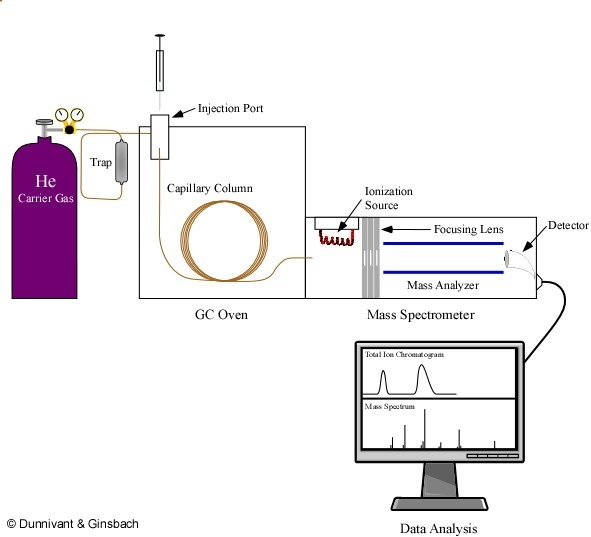
http://people.whitman.edu/~dunnivfm/C_MS_Ebook/CH2/Figures/Fig_2_5_GC-MS.jpg
BPA extraction: QuEChERS (Quick Easy Cheap Effective Rugged Safe.)
1. 10 grams of food samples were homogenized
for analysis by stainless steel blender together with 10ml of acetonitrile and spiked with BPA d16 as internal standard
2. In a plastic centrifuge tube, 10 g sample +
1.0 g NaCl + 4 g MgSO4 +10 ml acetonitrile were shaken for 2 minutes. (Phase-separation).
3. The mixture was centrifuged for 10 minutes
at 4000 RPM.
4. Take an aliquot of the upper organic phase
and subject it to dispersive Solid Phase Extratction clean-up by mixing it with MgSO4 and a
sorbent (e.g. Primary-Secondary Amines) to remove water and undesired
co-extractives.

http://www.biotage.com/graphics/9224.jpg
5. Sample was microfuged at 10,000 RPM and the supernatant is transferred into a GC vial.
2. Obtain the mass spectrum of the sample. 3. Compare with BPA mass spectrum from the library. .jpg)
Quantitative (Internal Standard)
1.Prepare 5 known standards of BPA with different concentrations, using acetonitrile as a solvent and BPA d16 as the internal standard. 2.Use an auto sampler to inject 1 µL of each standard solution to see the detector response at each concentration level. 3.The normalised peak area is plotted against the concentration of the BPA standard to obtain the calibration graph. 4. Inject 1µL of the sample with contains BPA and introduce it into the GC-MS. 5. Calculate the concentration of BPA in the sample by using the calibration graph. GC conditions:  
http://www.crawfordscientific.com/images/GC/agilent_DB5_HP5_HP5ms.jpg
References: Szyrwińska, K. et al. (2007) DERIVATIZATION AND GAS CHROMATOGRAPHY–LOW-RESOLUTION MASS SPECTROMETRY OF BISPHENOL A. [e-book] Poznań, Poland: p.54. Available through: Google http://www.us.edu.pl/uniwersytet/jednostki/wydzialy/chemia/acta/ac18/zrodla/05_AC18.pdf [Accessed: 21st January 2013]. JORDÁKOVÁ, I. et al. (2003) Determination of Bisphenol A, Bisphenol F, Bisphenol A Diglycidyl Ether and Bisphenol F Diglycidyl Ether Migrated from Food Cans using Gas Chromatography-Mass Spectrometry. [e-book] Prague, Czech Republic: p.86-87. Available through: Google http://www.agriculturejournals.cz/publicFiles/50833.pdf [Accessed: 21st January 2013]. Wang, X. et al. (2011) UCT Food Safety Application Modified QuEChERS Procedure for the Analysis of Bisphenol A in Canned Food Products. [e-book] Bristol, Pennsylvania: p.3. Available through: Google http://www.unitedchem.com/sitefiles/applications/The_Analysis_of_Bisphenol_A.pdf [Accessed: 22nd January 2013]. Quechers.cvua-stuttgart.de (2011) QuEChERS. [online] Available at: http://quechers.cvua-stuttgart.de/ [Accessed: 25 Jan 2013]. |
And the awesome Jaclyn Ng  Dedicated to Mr Liew Profile Two absolutely non-mugger students
MBIO 2F02 INAC Project Blog Tagboard stay away. nono don't post here.
Affiliates NONE. We work alone.
Archives None. Because duh.
»January 2013 Credits Just so we aren't prosecuted for stealing
Manipulation : Jac & Hongyi. | |